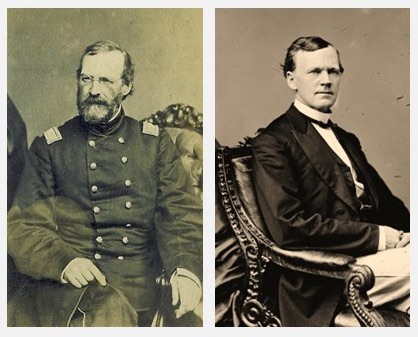
John Richter Jones (Author’s Collection) and Carlton B. Curtis (Brady-Handy Collection, Library of Congress).
On July 22, 1861—just one day after Major General Irvin McDowell’s Federal Army suffered an unqualified defeat at Manassas, Virginia—the United States Congress passed an act that authorized the president “to accept the services” of up to five hundred thousand volunteer troops to meet necessities. When a subsequent decision doubled the authorization a few days later, the nation’s perilous situation became apparent to most Americans and amidst patriotic appeals, recruiting began across the Union’s remaining states.
Among the Pennsylvanians who entered the race to enroll soldiers were John Richter Jones and Carlton Brandaga Curtis. Both were ambitious men who leveraged the positions they enjoyed within their communities, but they represented different political beliefs and lived at opposite ends of the state. Their shared aspirations affected the formation and service of what became the 58th Pennsylvania Volunteers.
Jones was a Philadelphia lawyer and judge from a prominent family with a history of military service. He held staunch anti-abolitionist Democratic views but was opposed to any state’s right to secede from the United States. In August of 1861 when he received authority to raise a regiment of volunteers, he was fifty-seven years old and living in retirement at the home he purchased in rural Eaglesmere, Sullivan County, Pennsylvania. He established a camp of instruction near his former Roxborough home, where he became known for strict discipline and aggressive leadership in the drilling of his recruits.
Curtis was born in New York in 1811 and became a lawyer and politician in Western Pennsylvania, where he represented Warren County in the state legislature and the U.S. House of Representatives. Elected as a Democrat, he joined the Republican party in 1855. Like Jones, he received authority to raise a regiment of volunteers, but despite his canvassing of the towns in the rural western part of the state, he failed to recruit the thousand or so men necessary to form a regiment.
Jones likewise failed also to enroll enough men and the two unfinished organizations, augmented with an independent company raised in central Pennsylvania, were merged to form a single regiment. Curtis’ regiment had been designated the 114th Pennsylvania Volunteers, but since Jones’ was the 58th Pennsylvania Volunteers, the lower number received priority and Jones became colonel. Curtis was mustered in as lieutenant colonel and served as the older man’s deputy.
After Jones was killed by a sniper in May 1863 while serving with his regiment as commander of New Bern, North Carolina’s outposts, Curtis was commissioned colonel and commanded the 58th Pennsylvania for a short time before he resigned his commission in July 1863. He moved to Erie in 1868, where he continued to practice law, engaged in several successful business ventures and was elected as a Republican to the Forty-third Congress. Unsuccessful in his bid for reelection in 1874, he resumed the practice of law and died in Erie in 1883.


Leave a Reply