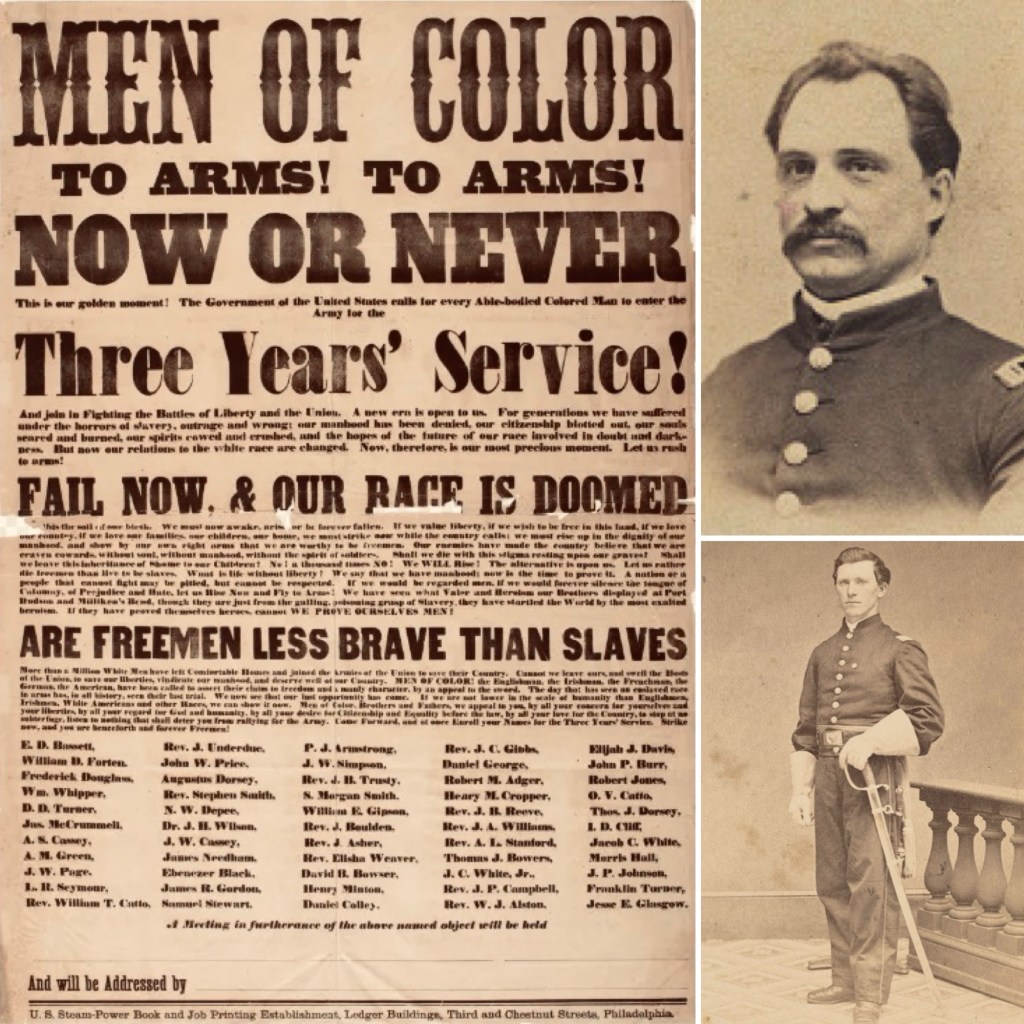
Black History Month provides an opportunity to share briefly the stories of five soldiers who were mustered into the 58th Pennsylvania Volunteers and later accepted appointments as officers in regiments comprised of men of color.
In addition to proclaiming the freedom of enslaved people in the ten states that remained in rebellion, President Abraham Lincoln’s January 1, 1863 Emancipation Proclamation ordered that “suitable” persons among those freed could be enrolled into paid military service. Several months later, General Order No. 143 established the Bureau of Colored Troops to oversee the recruitment and organization of regiments of black soldiers, which were to be led by white officers, typically recruited from existing regular army units.
By early 1864, an idea promoted primarily by abolitionist politicians matured to an immediate need to man, train and equip fighting regiments of men of color for the upcoming campaigning season. Historian Dudley Taylor Cornish, in his 1987 book The Sable Arm: Black Troops in the Union Army, wrote, “The whole movement to arm the Negro moved off its original amateurish, haphazard, and volunteer basis to a new footing of professional, organized, regularized activity under central control from Washington.”
Most state-raised Black units were renamed and assimilated into the United States Colored troops (USCT) to provide uniform numbering and organization. The professionalization also introduced a more rigorous federal examination process for officer candidates that included exams and appearances before selection boards prior to appointment in the new USCT regiments. In the 58th Pennsylvania, five men displayed the proper qualities and earned commissions as USCT officers.
Company C’s Private Samuel Smith was mustered into the 30th U.S.C.T. on February 29, 1864. He survived the chaos of the fight in the Crater explosion near Petersburg on July 30, 1864 and was a prisoner of the Confederacy for seven months at Camp Asylum, Columbia, South Carolina. He was mustered out on December 10, 1865.
John W. Migrath, also of Company C, had served in the 19th Pennsylvania Infantry (3 months) before joining the 58th Pennsylvania and was first sergeant of his company when he was promoted to captain, U.S. Colored Troops on February 5, 1864. He organized and commanded Company B, 25th U.S.C.T., which was assigned to Barrancas, Florida, where Migrath was dismissed on November 22, 1864.
Another 58th Pennsylvania first sergeant, William E. Moses of Company H, was discharged on April 29, 1864 to accept an appointment in Company C of the newly formed 1st North Carolina Colored Heavy Artillery (later 14th U. S. Colored Heavy Artillery). Critical shortages of officers limited the battalion’s potential, and it remained in the defenses of eastern North Carolina throughout the remainder of the war. Moses was mustered out as a captain with his company on December 11, 1865.
George A. Dubree was just 18 years old when he joined Company D of the 58th Pennsylvania on December 17, 1861. Promoted to sergeant on June 14, 1863, he applied for a commission in the USCT and was mustered as sergeant major of the 117th U.S.C.T. on November 25, 1864. In April 1865, he became one of the first Federal soldiers to enter Richmond with his regiment as part of the all-Black XXV Corps. He was mustered out of the service on December 11, 1865.
On August 17, 1864, Sergeant William A. Moore of Company E accepted a promotion to captain of Company B, 2nd North Carolina (Union) Infantry at Beaufort, North Carolina. The following February, he was mustered out to accept the commission of major in 14th U.S. Colored Heavy Artillery, with whom his former comrade Moses already served. He remained with this organization in the garrison of New Bern and later at Beaufort until it was mustered out on December 11, 1865.


Leave a Reply