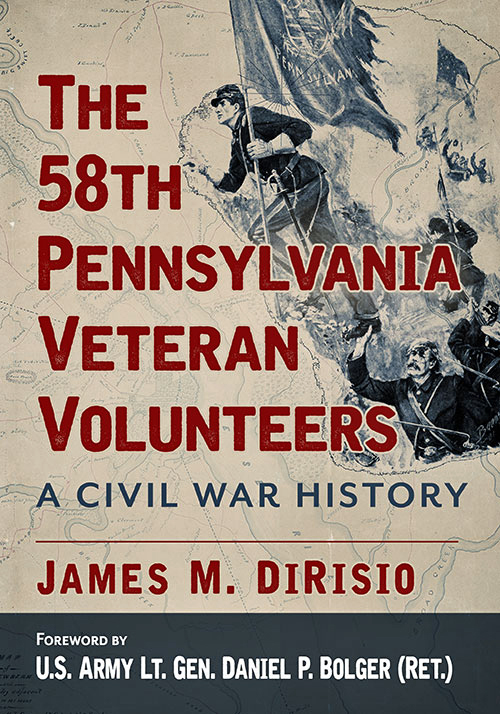
I am pleased to share that the team McFarland and Co. has sent me the approved art for the cover of my regimental history of the 58th Pennsylvania Veteran Volunteers that they will be publishing in early 2027.
The team created an extraordinary visual that captures the theme of my manuscript, which explores the regiment’s service with a particular emphasis on its military operations from outpost duty in Virginia and North Carolina beginning in 1862 to the storming of Fort Harrison’s ramparts in September 1864.
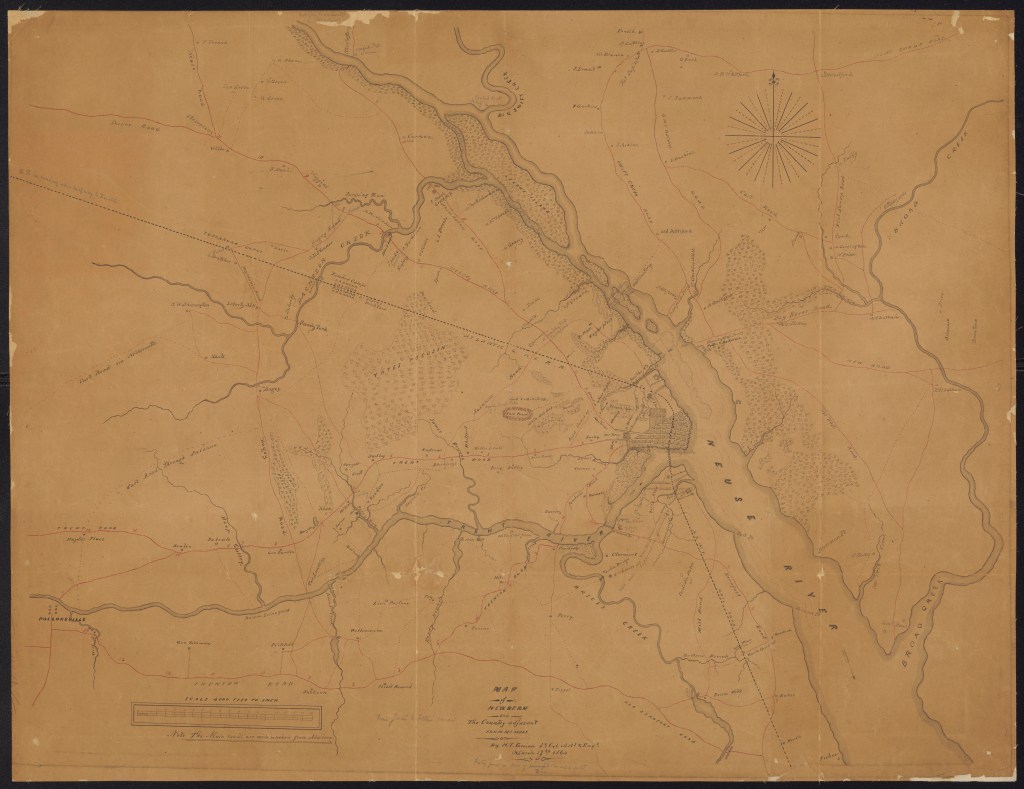
As a background, the graphic artist incorporated an image of the map that 1st Regiment North Carolina Artillery Lieutenant Colonel Henry Tillman Guion drew of the terrain west of the city of New Bern, North Carolina. It depicts where the 58th Pennsylvania occupied a series of earthworks in the vicinity of Batchelder’s Creek and many of the places where it soldiers conducted reconnaissance and raids toward Kinston. The original map, which Duke University’s David M. Rubenstein Rare Book & Manuscript Library, was very kind to allow me to reproduce, is an exquisitely detailed 1:48,000 drawing in India ink, red ink, and pencil that is mounted on linen. For the cover of the book, the map will “bleed” across all four edges and wrap from the front, across the spine, and onto the back cover.
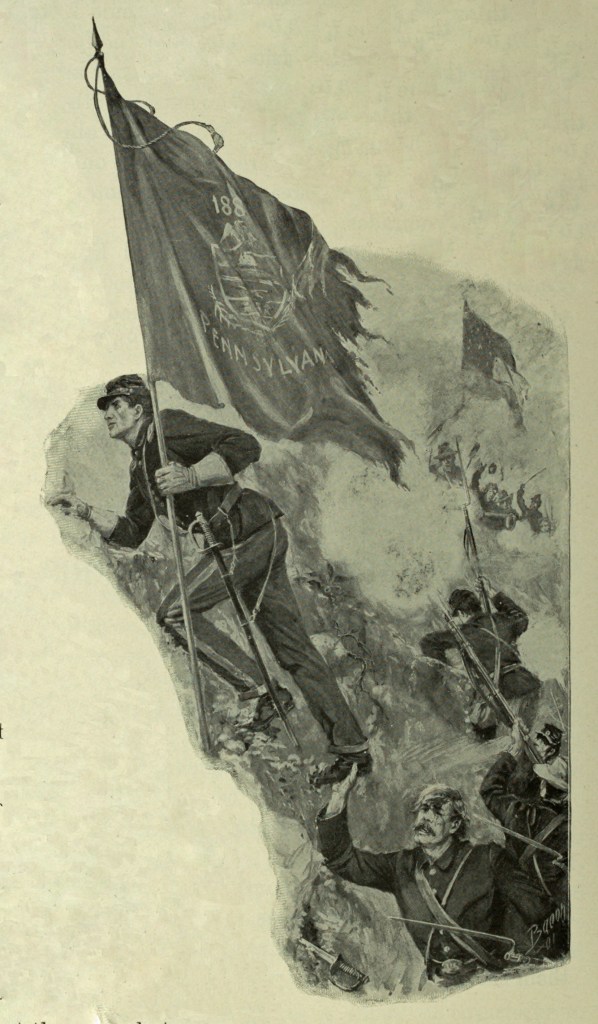
The second graphic element of the cover is an image of then Captain Cecil Clay carrying the colors of the 188th Pennsylvania Volunteers (a sister regiment in the Third Brigade, First Division, XVIII Army Corps) to the ramparts of Fort Harrison during the September 29, 1864 fighting around Chaffin’s Farm, Virginia. This is one of 98 illustrations that prominent American illustrator and painter Irving R. Bacon (1875–1962) contributed to Deeds of Valor: How America’s Civil War Heroes Won the Congressional Medal of Honor. First published as a two-volume edition in 1903 by Detroit’s Perrien-Keydel Company, this work included a capsule history of Clay’s actions on September 29 accompanied by the detailed engraving of Bacon’s tempera paint on illustration board original artwork. Despite having to produce nearly one hundred illustrations, Bacon rendered an accurate drawing that captured Clay’s remembrance of the event, even depicting Private Billy Bourke as the “sandy haired Irishman” boosting him up as Clay described. The image, due to the copyright year of Deeds of Valor, is in the public domain and available in high resolution.
The typography is from digital fonts of typefaces that are similar to Victorian era gothic or sans serif faces like Philadelphia Lining Gothic. The ever-so-slightly distressed appearance of the letters is a great nod to my practice of letterpress printing that I learned from father. The color pallet also is reminiscent of 19th century printing and I really appreciate that the combination of deep-toned hues contrasts with that of many modern American Civil War books.
The 58th Pennsylvania Veteran Volunteers: A Civil War History will be available for pre-order before the end of 2026 and will be published in early 2027. Watch this block for more news and updates.


Leave a comment