From the Outposts to the Ramparts

The Virtual Home of the 58th Pennsylvania Veteran Volunteers

  • When AI Gets Trippy (A Civil War Research Vignette)

    The folks at Emerging Civil War are looking at AI in the history field for the next week or so, which prompted me to share this vignette about a halucination Gemini AI tried to inflict on me.

    Lighting director Chip Monck famously announced to the crowd at the 1969 Woodstock Festival, “The warning that I received, you may take with however many grains of salt you wish, that the brown acid that is circulating around us, is specifically not too good. It’s suggested that you do stay away from that; of course, it’s your own trip, so, be my guest. But, please be advised that there is a warning on that one.”

    When it comes to AI-enabled web searching, researchers may want to heed Chip’s advice.

    A recent MIT Sloan Teaching & Learning Technologies report cited OpenAI’s own research when it noted, “Despite this increased accuracy, recent evaluations have indicated that advanced reasoning models still do not consistently eliminate hallucinations; during multi-step reasoning, the models make “strategic guesses” where they generate plausible but false statements when uncertain.”

    My recent experience demonstrates a need to continually question results that AI-enabled web searches generate. Unless one crafts a query with appropriate caveats (and those can very, depending upon the search engine), AI-enablers have a tendency to “hallucinate” when attempting to answer questions for which they are not optimized to analyze.

    When an AI-enabled search engine blends traditional database retrieval with a Generative AI or Large Language Model (LLM), the tendency to “hallucinate” produces what my years in the Army taught me to call an MSU (Make Stuff Up) experience. This most commonly happens in the “data void” that your AI encounters when searching for a low information topic. When the search is “for something obscure, niche, or hyper-local, there isn’t enough reliable training data or live search results for the AI to pull from,” according to, yes…Google Gemini.

    The AI model attempts to “fill in the blanks” by accessing patterns from its training data, that can result in highly plausible-sounding but entirely fabricated facts, names, or events.

    My specific experience with a very convincing hallucination began when I asked Google Gemini to assist me with my material analysis of Louis N. Boudrye’s (also Beaudry) Historic Records of the Fifth New York Cavalry. Realizing that four different editions are digitized and available online, I typed a simple and unqualified query into Google Gemini: “I am interested in the details of typography in the multiple editions of Beaudry’s ‘Historic Records of the Fifth New York Cavalry.’”
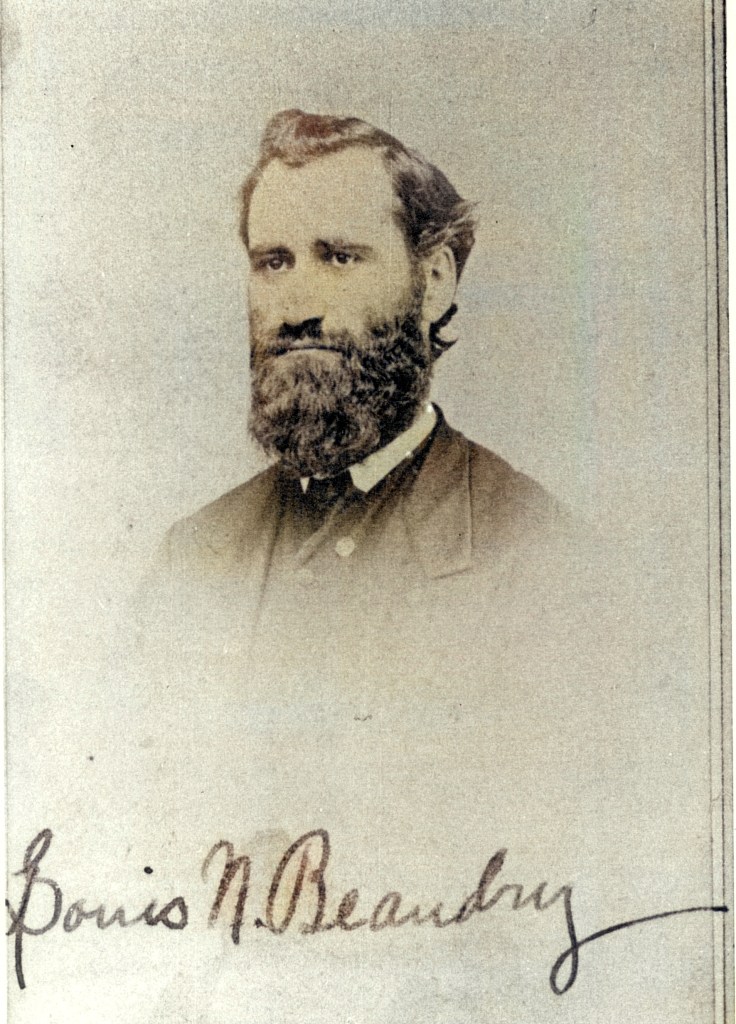
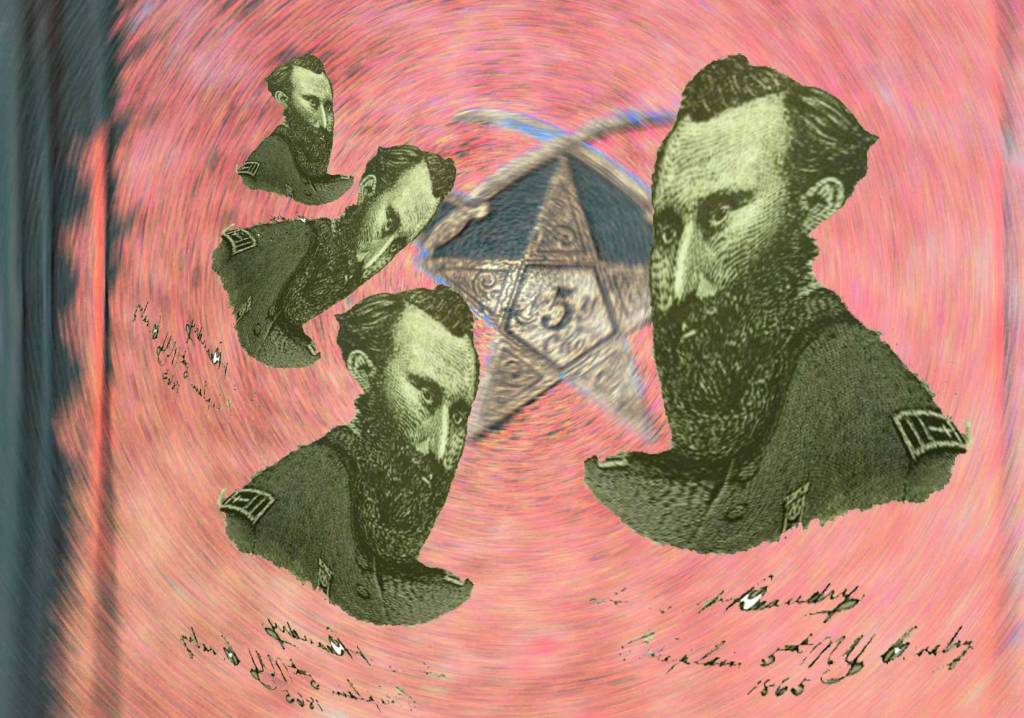
    Louis Napolen Boudrye (also spelled Beaudry) was the chaplain of the 5th New York Cavalry and the author of its regimental history, which was published in four editions between 1865 and 1874 (FindaGrave.com).

    Almost instantaneously, Gemini produced two apparently authoritative and articulate summaries—one each for the 1865 First Edition and another for the 1868 Enlarged Third Edition. If I did not previously know a little bit about the 5th New York Cavalry, and perhaps a little more about letterpress printing, relying on these two paragraphs could have led me into a potentially embarrassing—or professionally damaging—situation.

    Contrary to the hallucination that Gemini dreamed up, neither edition includes chapter initials set in “basic, unadorned drop-caps.” The compositors who set the types used no drop caps at all in any part of the book. Additionally, despite Gemini’s assertion that C. Van Benthuysen printed the book, the front matter includes a page that clearly states, “J. Munsell, Printer.” Nowhere in the book does Van Benthuysen’s name appear, and subsequent searches produces no association of Van Benthuysen with Boudrye or his history of the 5th New York Cavalry.

    Gemini’s hallucination about the 1868 Enlarged Edition (which it correctly identified as the Third Edition), was even more trippy…and might have tripped up a more casual historian. It began with the sentence, “When Joel Munsell took over the printing in 1868, the typography shifted dramatically.” This is problematic for two reasons. First, as demonstrated above, Joel Munsell was the printer of the First Edition. Second, the typography did not shift at all. The portion of the main text that was in the first edition (pages 17 through 358) are identical in the third edition. The paginations and line justifications are identical and the idiosyncratic typographic artifact of two upside-down commas being used to form opening double quotations appear in both texts. The only changes are some minor edits to the front matter (some of which were carried over from the Second Edition, which also appeared in 1865) and the addition of new content in pages 359 through 385.
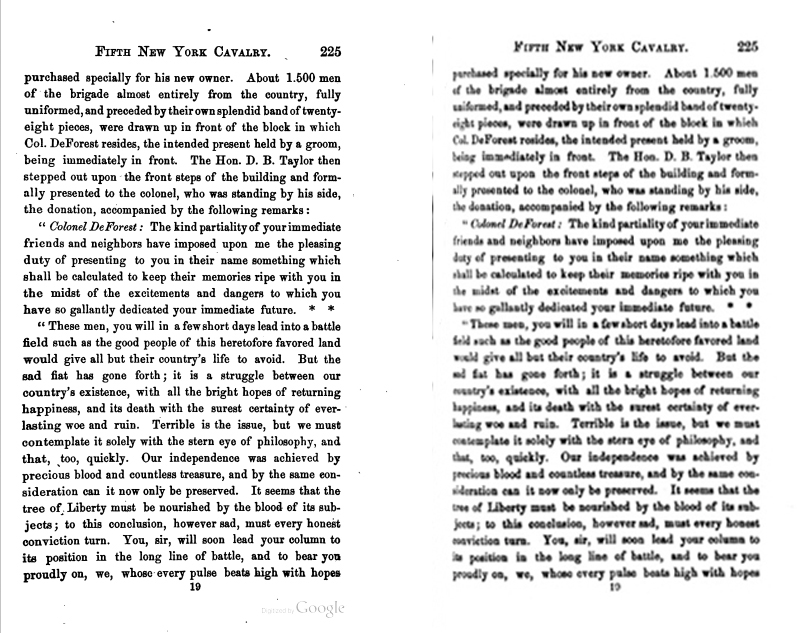
    The 1865 First Edition and 1868 Enlarged Third Edition of Boudrye’s Historic Records of the Fifth New York Cavalry. Despite Google’s Gemini analysis, they are typographicvally identical (although the digitized version of the Third Edition is an inferior scanned product.

    Gemini’s claim that “Munsell despised the cold, high-contrast Modern Roman typefaces common in the 1860s” has no basis in anything published about Munsell. “The hallucination’s further assertion that, “For the 1868 edition, he utilized an Old Style typeface (akin to Franklin Old Style or Caslon), which featured bracketed serifs, lower contrast, and an overall darker, warmer text block that was much easier on the eyes” is also a fabrication. As noted previously, the text is identical because, almost certainly, Munsell relied on stereotypes, or a kind of cloning, of the original hand-composed types. These would have withstood the pounding of the high speed press better than a form composed of metal types and also would have been able to be stored for reuse on future printings. Another giveaway that the printer used stereotypes is the errant “19” that appears at the bottom of each edition’s page 225.
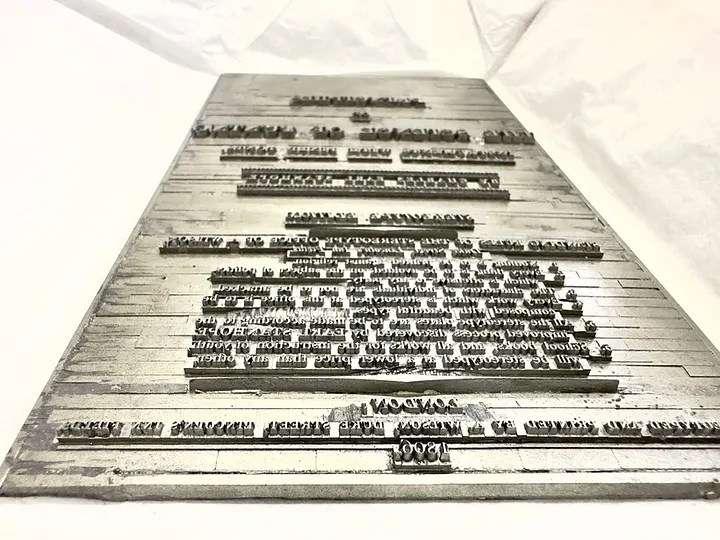
    A stereotype plate of the title page of Stanhope’s The Principles of the Science of Tuning (St Bride Foundation, shelf number 1647A, “2x Stanhope Stereo Plates). (Glenn Fleishman at https://glennf.medium.com/touching-the-past-on-a-london-visit-the-stanhope-molds-and-plates-a00a2e98e54f)

    Among Gemini’s other hallucinations, the third edition has no “Signature Typographic Ornaments,” no changes in type sizes to accommodate the additional pages, and no discernible changes to the typography of the title page.
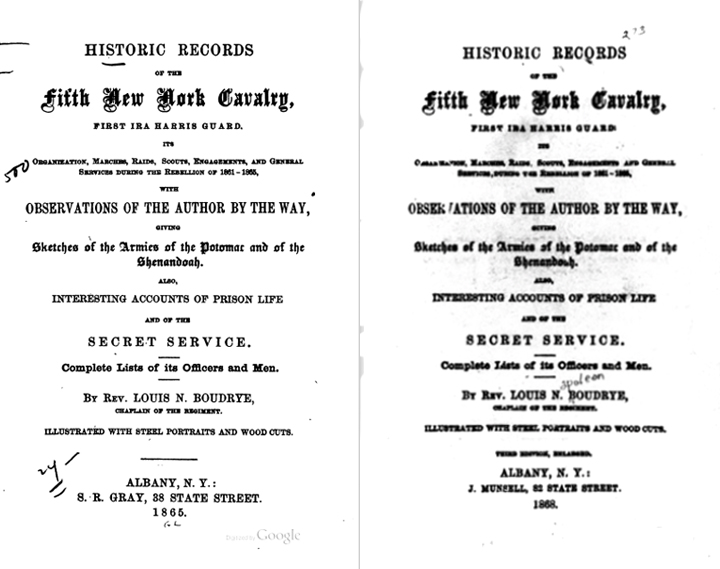
    The title pages of the First (left) and Third (right) editions, despite Gemini’s attempt to analyze their 19th Century typographical attributes) are nearly identical. The only changes in the Third edition are the deletion of the horizontal rule at the bottom of the First Edition and its being replaced with the new edition information. Note that J. Munsell printed boith editions, but the First Edition showed New York stationer S. R. Gray’s name, as he coordinated the book’s first publishing.

    So, just like Chip told the groovy people at Woodstock, if you indulge in AI for your internet searches, know that it comes with a warning.
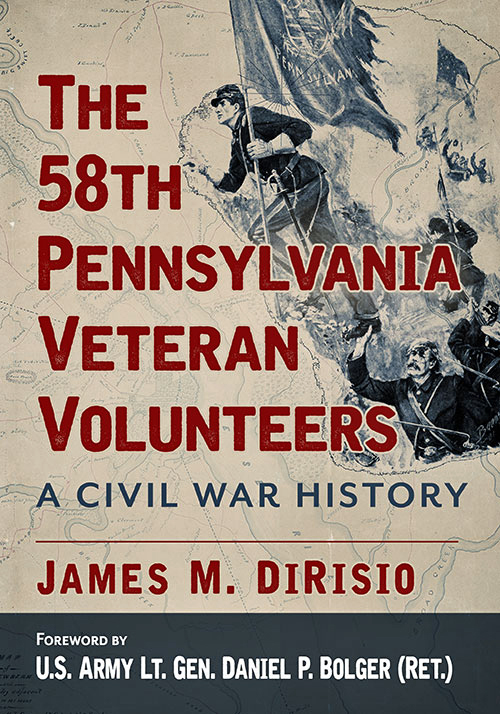
  • I am pleased to share that the team McFarland and Co. has sent me the approved art for the cover of my regimental history of the 58th Pennsylvania Veteran Volunteers that they will be publishing in early 2027.

    The team created an extraordinary visual that captures the theme of my manuscript, which explores the regiment’s service with a particular emphasis on its military operations from outpost duty in Virginia and North Carolina beginning in 1862 to the storming of Fort Harrison’s ramparts in September 1864.

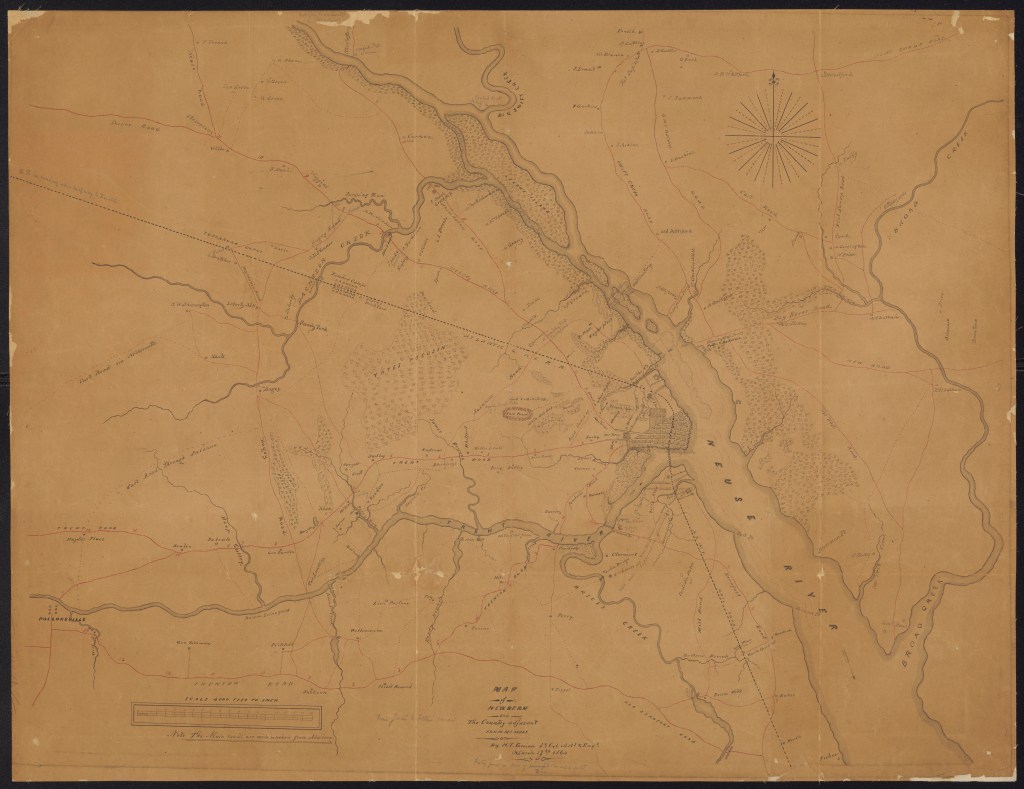
    As a background, the graphic artist incorporated an image of the map that 1st Regiment North Carolina Artillery Lieutenant Colonel Henry Tillman Guion drew of the terrain west of the city of New Bern, North Carolina. It depicts where the 58th Pennsylvania occupied a series of earthworks in the vicinity of Batchelder’s Creek and many of the places where it soldiers conducted reconnaissance and raids toward Kinston. The original map, which Duke University’s David M. Rubenstein Rare Book & Manuscript Library, was very kind to allow me to reproduce, is an exquisitely detailed 1:48,000 drawing in India ink, red ink, and pencil that is mounted on linen. For the cover of the book, the map will “bleed” across all four edges and wrap from the front, across the spine, and onto the back cover.

    Confederate artillerist Lieutenant Colonel Henry Tillman Guion’s March 1864 map of New Bern and vicinity is a highly detailed study of the approaches to the city, but as a graphic element, it is an excellent background for the cover of my forthcoming McFarland and Co. book, The 58th Pennsylvania Veteran Volunteers: A Civil War History. (David M. Rubenstein Rare Book & Manuscript Library)

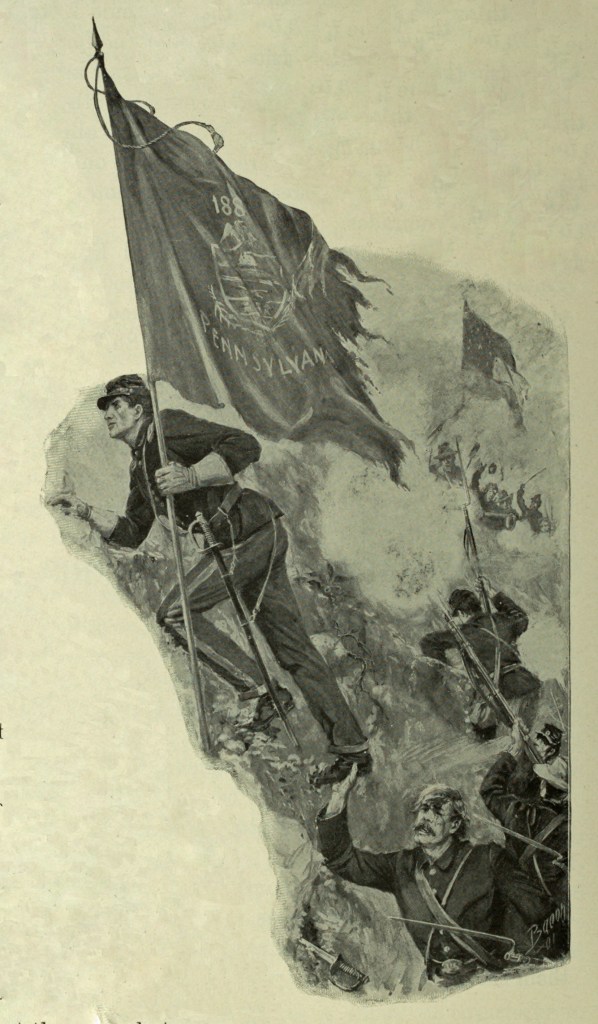
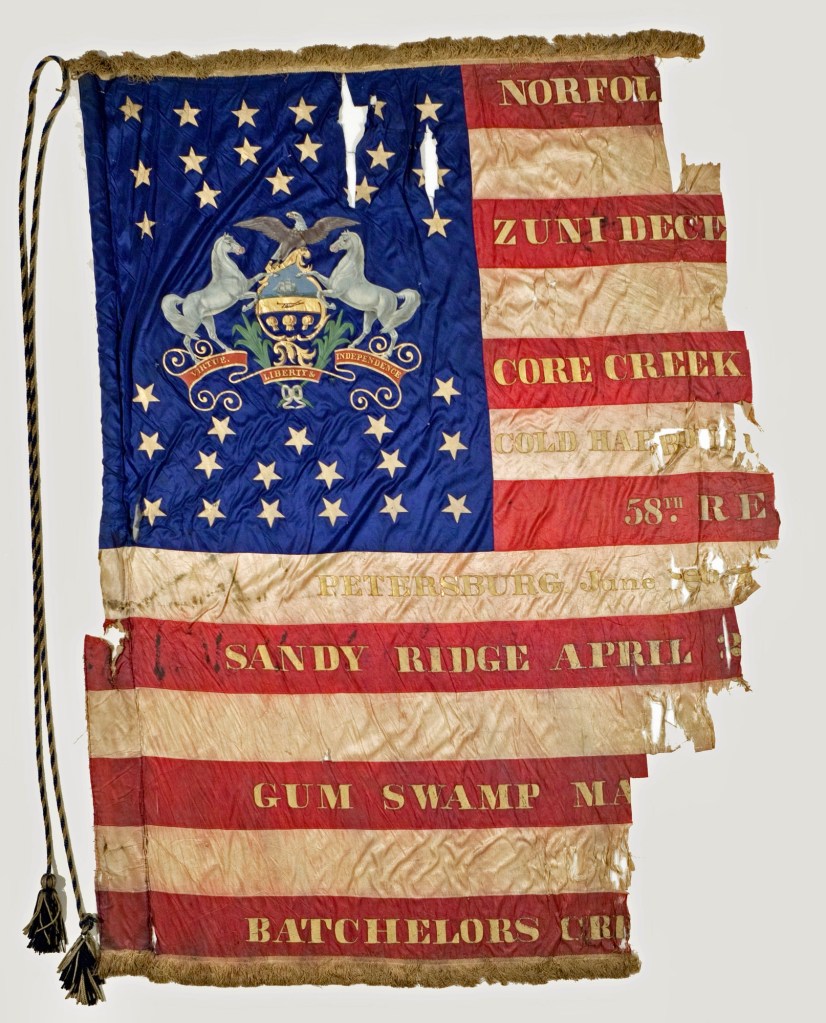
    The second graphic element of the cover is an image of then Captain Cecil Clay carrying the colors of the 188th Pennsylvania Volunteers (a sister regiment in the Third Brigade, First Division, XVIII Army Corps) to the ramparts of Fort Harrison during the September 29, 1864 fighting around Chaffin’s Farm, Virginia. This is one of 98 illustrations that prominent American illustrator and painter Irving R. Bacon (1875–1962) contributed to Deeds of Valor: How America’s Civil War Heroes Won the Congressional Medal of Honor. First published as a two-volume edition in 1903 by Detroit’s Perrien-Keydel Company, this work included a capsule history of Clay’s actions on September 29 accompanied by the detailed engraving of Bacon’s tempera paint on illustration board original artwork. Despite having to produce nearly one hundred illustrations, Bacon rendered an accurate drawing that captured Clay’s remembrance of the event, even depicting Private Billy Bourke as the “sandy haired Irishman” boosting him up as Clay described. The image, due to the copyright year of Deeds of Valor, is in the public domain and available in high resolution.

    One of 98 illustrations that Irving R. Bacon drew for the 1903 book Deeds of Valor: How America’s Civil War Heroes Won the Congressional Medal of Honor, this drawing depicts Cecil Clay, aided by Billy Bourke, climbing to the top of Fort Harrison’s rampart. (HathiTrust)

    The typography is from digital fonts of typefaces that are similar to Victorian era gothic or sans serif faces like Philadelphia Lining Gothic. The ever-so-slightly distressed appearance of the letters is a great nod to my practice of letterpress printing that I learned from father. The color pallet also is reminiscent of 19th century printing and I really appreciate that the combination of deep-toned hues contrasts with that of many modern American Civil War books.

    The 58th Pennsylvania Veteran Volunteers: A Civil War History will be available for pre-order before the end of 2026 and will be published in early 2027. Watch this block for more news and updates.

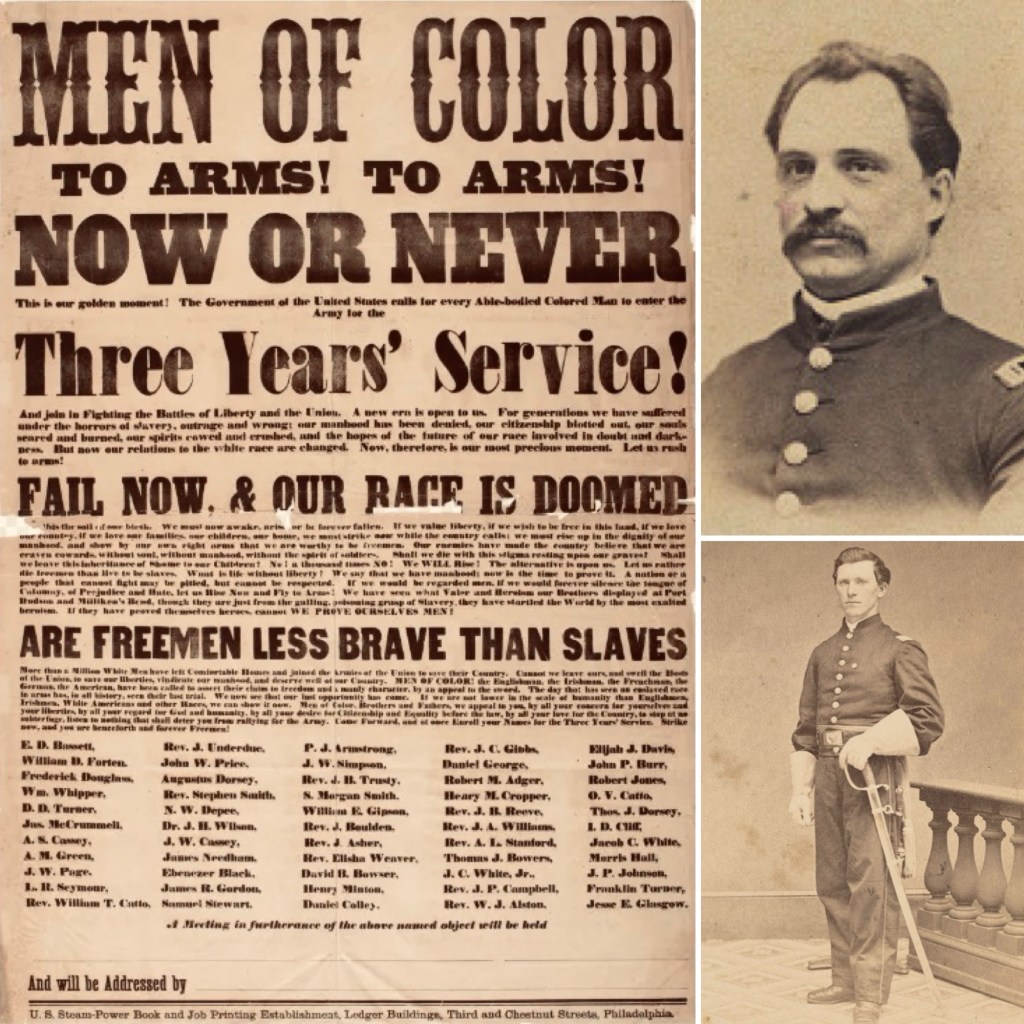
  • Recruiting broadside (Collection of the Smithsonian National Museum of African American History and Culture) and images of John W. Migrath (top right) and Samuel Smith (bottom right). (Library of Congress)

    Black History Month provides an opportunity to share briefly the stories of five soldiers who were mustered into the 58th Pennsylvania Volunteers and later accepted appointments as officers in regiments comprised of men of color.

    In addition to proclaiming the freedom of enslaved people in the ten states that remained in rebellion, President Abraham Lincoln’s January 1, 1863 Emancipation Proclamation ordered that “suitable” persons among those freed could be enrolled into paid military service. Several months later, General Order No. 143 established the Bureau of Colored Troops to oversee the recruitment and organization of regiments of black soldiers, which were to be led by white officers, typically recruited from existing regular army units.

    By early 1864, an idea promoted primarily by abolitionist politicians matured to an immediate need to man, train and equip fighting regiments of men of color for the upcoming campaigning season. Historian Dudley Taylor Cornish, in his 1987 book The Sable Arm: Black Troops in the Union Army, wrote, “The whole movement to arm the Negro moved off its original amateurish, haphazard, and volunteer basis to a new footing of professional, organized, regularized activity under central control from Washington.”

    Most state-raised Black units were renamed and assimilated into the United States Colored troops (USCT) to provide uniform numbering and organization. The professionalization also introduced a more rigorous federal examination process for officer candidates that included exams and appearances before selection boards prior to appointment in the new USCT regiments. In the 58th Pennsylvania, five men displayed the proper qualities and earned commissions as USCT officers.

    Company C’s Private Samuel Smith was mustered into the 30th U.S.C.T. on February 29, 1864. He survived the chaos of the fight in the Crater explosion near Petersburg on July 30, 1864 and was a prisoner of the Confederacy for seven months at Camp Asylum, Columbia, South Carolina. He was mustered out on December 10, 1865.

    John W. Migrath, also of Company C, had served in the 19th Pennsylvania Infantry (3 months) before joining the 58th Pennsylvania and was first sergeant of his company when he was promoted to captain, U.S. Colored Troops on February 5, 1864. He organized and commanded Company B, 25th U.S.C.T., which was assigned to Barrancas, Florida, where Migrath was dismissed on November 22, 1864.

    Another 58th Pennsylvania first sergeant, William E. Moses of Company H, was discharged on April 29, 1864 to accept an appointment in Company C of the newly formed 1st North Carolina Colored Heavy Artillery (later 14th U. S. Colored Heavy Artillery). Critical shortages of officers limited the battalion’s potential, and it remained in the defenses of eastern North Carolina throughout the remainder of the war. Moses was mustered out as a captain with his company on December 11, 1865.

    George A. Dubree was just 18 years old when he joined Company D of the 58th Pennsylvania on December 17, 1861. Promoted to sergeant on June 14, 1863, he applied for a commission in the USCT and was mustered as sergeant major of the 117th U.S.C.T. on November 25, 1864. In April 1865, he became one of the first Federal soldiers to enter Richmond with his regiment as part of the all-Black XXV Corps. He was mustered out of the service on December 11, 1865.

    On August 17, 1864, Sergeant William A. Moore of Company E accepted a promotion to captain of Company B, 2nd North Carolina (Union) Infantry at Beaufort, North Carolina. The following February, he was mustered out to accept the commission of major in 14th U.S. Colored Heavy Artillery, with whom his former comrade Moses already served. He remained with this organization in the garrison of New Bern and later at Beaufort until it was mustered out on December 11, 1865.

  • With great excitement, I announce that Jefferson, North Carolina publisher McFarland and Company, Inc. will be publishing my manuscript as a regimental history of the 58th Pennsylvania Veteran Volunteers.

    The next few months are going to be busy, as I compile the final elements of more than thirty years of research to ensure this book is worthy of the legacy of the men about whom I have written.

    The anticipated delivery date is some time in 2027. As the process evolves, I will be posting updates on this site.

    Thank you to Sophia Lyons and Rhonda Herman at McFarland for their confidence in me and their interest in telling the story of the 58th Pennsylvania. Huzzahs!

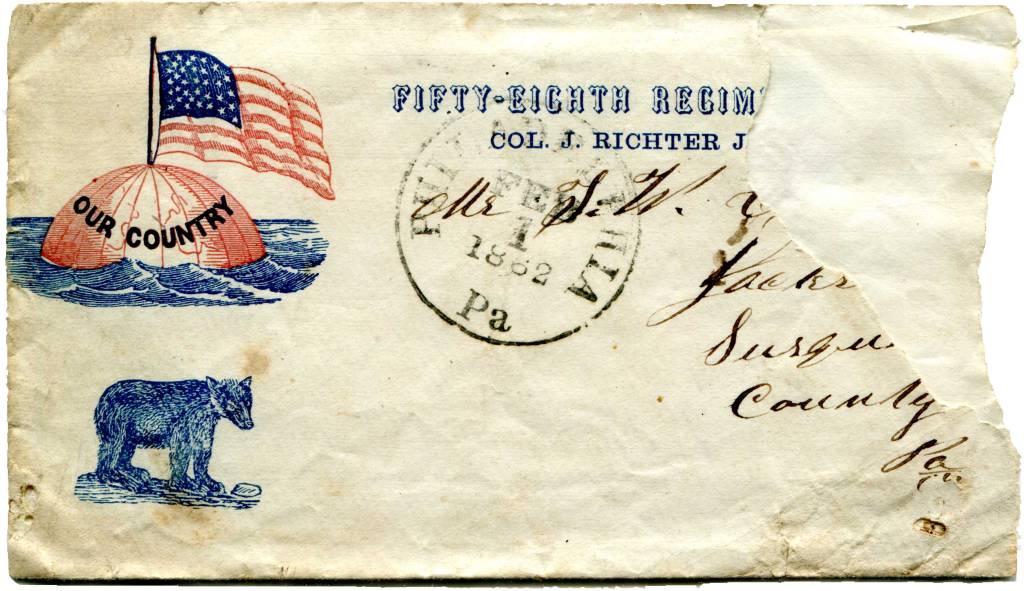
  • A black bear from the mountains of Sullivan County was the 58th Pennsylvania’s mascot during its 1861 organization and until the August 1864 veterans furlough. (Detail from envelope in author’s collection and CBS News photo)

    Amidst the boredom and horror of the American Civil War, moments of shared humanity and special camaraderie often emerged. One such fascinating detail about the 58th Pennsylvania Volunteers is the story of their unusual, furry companion: a bear named “Abe.”

    Colonel John Richter Jones acquired Abe near his Sullivan County, Pennsylvania home in the midst of recruiting men for a Civil War regiment. As a regimental pet, Abe was particularly appropriate because many of the recruits (including almost all of Company B) called the county home and half of the original members of the regiment hailed from similar forest regions in the central and western parts of the state.

    More than a mere novelty, Abe’s presence among the soldiers of the 58th Pennsylvania played a significant role in fostering esprit d’ corps. The animal’s place was such that some soldiers even purchased stationery printed with an image of a bear alongside a martial scene.

    Drummer boy William S. Webster fondly referred to the animal as “Old Abe” and Captain Lucius Rogers humorously remarked that a poor performing colleague was not “fit to carry oats to old ‘Abe’ Jones’ Bear.”

    Department of North Carolina judge advocate Joseph L. Stackpole was aware of Abe and drew a comparison between the colonel and the fictional Baron of Bradwardine, whose courtyard featured a statue of a large bear. He even suggested that the motto, “Beware the bear” could be applied to Jones or the regiment, further highlighting the bear’s iconic status within the organization.

    Abe was a constant companion throughout most of the regiment’s service, even after Jones’ May 1863 death. His nephew Captain Cecil Clay likely became his caretaker when he commanded at Rodman’s Point near Washington, North Carolina in early 1864. Later that spring, Abe journeyed with the 58th Pennsylvania from North Carolina to Virginia, where he accompanied the men during the Bermuda Hundred campaign, survived the June 1864 Battle of Cold Harbor and endured subsequent assaults on Petersburg.

    The bear made the voyage back to Pennsylvania with the men who reenlisted and received their veterans furlough at the end of July 1864, but after the men returned to the Bermuda Hundred works in August, “Old Abe” disappeared from the regimental record, perhaps having been retired to live peacefully in his Sullivan County home when the furlough ended.


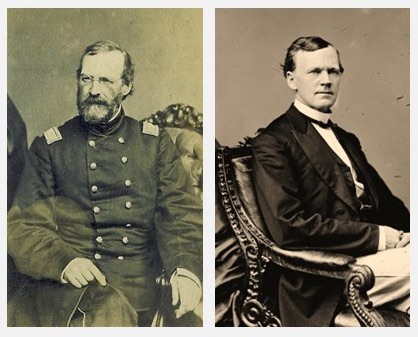
  • John Richter Jones (Author’s Collection) and Carlton B. Curtis (Brady-Handy Collection, Library of Congress).

    On July 22, 1861—just one day after Major General Irvin McDowell’s Federal Army suffered an unqualified defeat at Manassas, Virginia—the United States Congress passed an act that authorized the president “to accept the services” of up to five hundred thousand volunteer troops to meet necessities. When a subsequent decision doubled the authorization a few days later, the nation’s perilous situation became apparent to most Americans and amidst patriotic appeals, recruiting began across the Union’s remaining states.

    Among the Pennsylvanians who entered the race to enroll soldiers were John Richter Jones and Carlton Brandaga Curtis. Both were ambitious men who leveraged the positions they enjoyed within their communities, but they represented different political beliefs and lived at opposite ends of the state. Their shared aspirations affected the formation and service of what became the 58th Pennsylvania Volunteers.

    Jones was a Philadelphia lawyer and judge from a prominent family with a history of military service. He held staunch anti-abolitionist Democratic views but was opposed to any state’s right to secede from the United States. In August of 1861 when he received authority to raise a regiment of volunteers, he was fifty-seven years old and living in retirement at the home he purchased in rural Eaglesmere, Sullivan County, Pennsylvania. He established a camp of instruction near his former Roxborough home, where he became known for strict discipline and aggressive leadership in the drilling of his recruits.

    Curtis was born in New York in 1811 and became a lawyer and politician in Western Pennsylvania, where he represented Warren County in the state legislature and the U.S. House of Representatives. Elected as a Democrat, he joined the Republican party in 1855. Like Jones, he received authority to raise a regiment of volunteers, but despite his canvassing of the towns in the rural western part of the state, he failed to recruit the thousand or so men necessary to form a regiment.

    Jones likewise failed also to enroll enough men and the two unfinished organizations, augmented with an independent company raised in central Pennsylvania, were merged to form a single regiment. Curtis’ regiment had been designated the 114th Pennsylvania Volunteers, but since Jones’ was the 58th Pennsylvania Volunteers, the lower number received priority and Jones became colonel. Curtis was mustered in as lieutenant colonel and served as the older man’s deputy.

    After Jones was killed by a sniper in May 1863 while serving with his regiment as commander of New Bern, North Carolina’s outposts, Curtis was commissioned colonel and commanded the 58th Pennsylvania for a short time before he resigned his commission in July 1863. He moved to Erie in 1868, where he continued to practice law, engaged in several successful business ventures and was elected as a Republican to the Forty-third Congress. Unsuccessful in his bid for reelection in 1874, he resumed the practice of law and died in Erie in 1883.

  • Cecil Clay’s Unfinished Manuscript
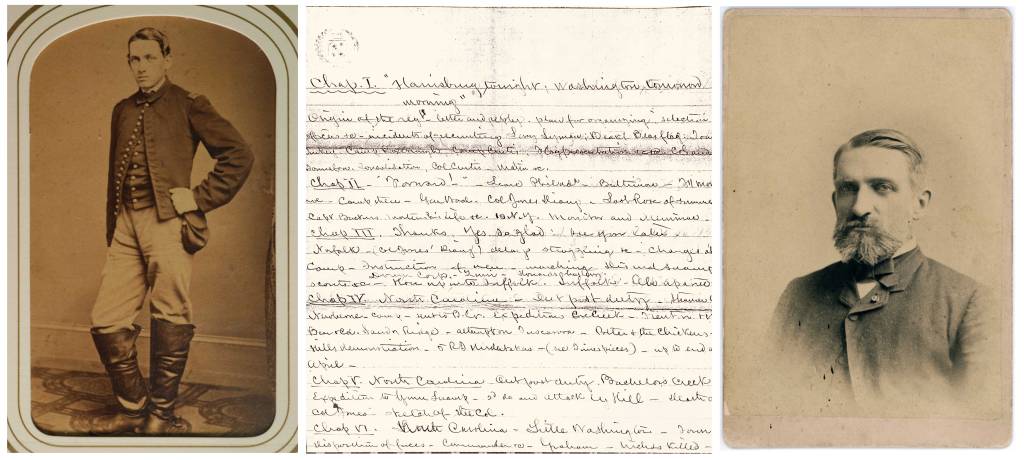
    Cecil Clay as he appeared during the Civil War (Ronn Palm Collection), the outline of his unfinished manuscript (Historical Society of Pennsylvania) and as he appeared near the end of his life (Author’s Collection).

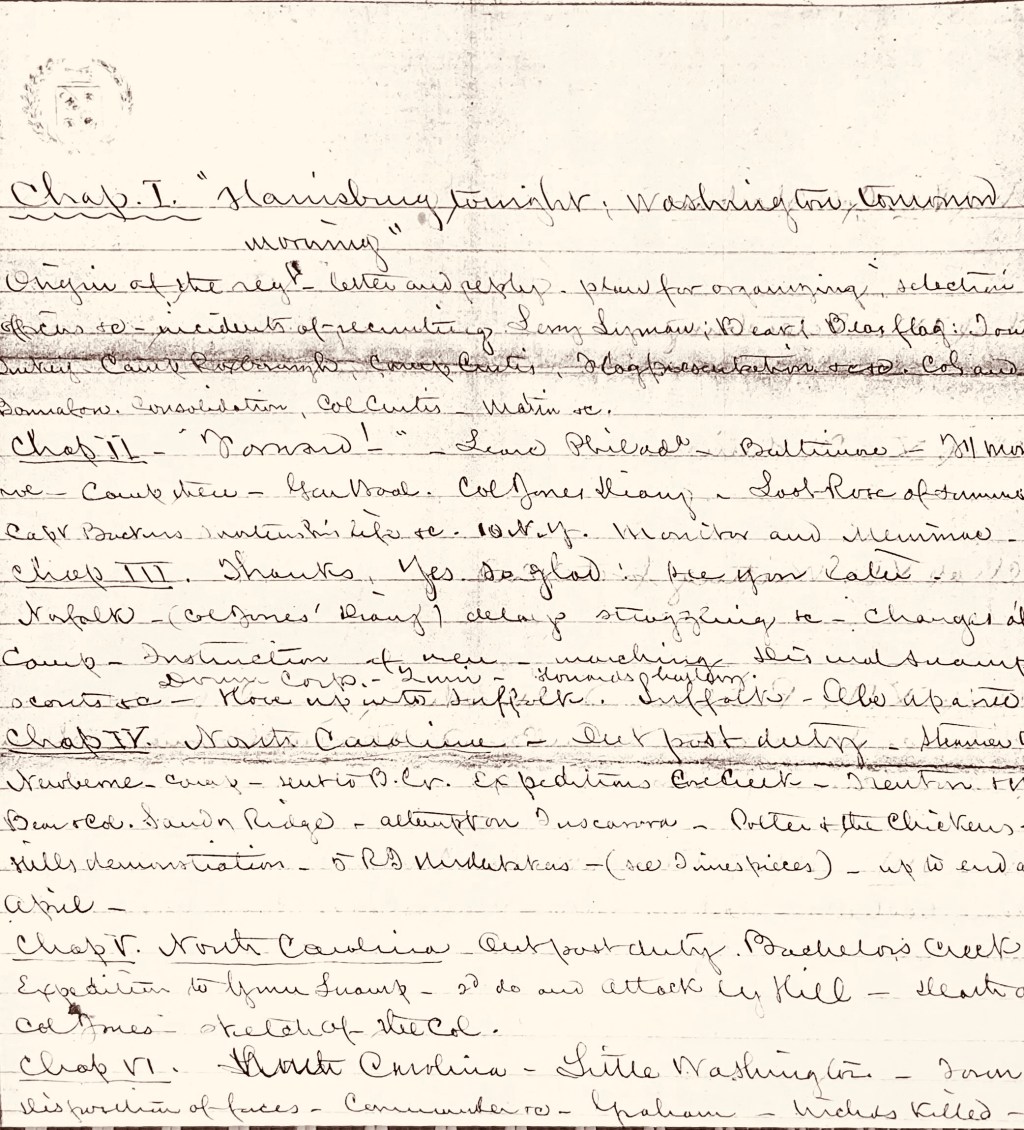
    The Historical Society of Pennsylvania’s Cecil Clay Papers include an outline of the regimental history that Cecil Clay (1842-1907) intended to publish, along with a fragment of its introduction. My attempt to tell the story that he began has brought me to the places where he and his comrades fought and lived. I have studied their words and those of their colleagues, enemies and others who had reason to write about them. The journey has lasted so much longer than I ever intended.

    Clay was not the first man to command the 58th Pennsylvania Volunteers. Rather, he was the nephew of Colonel John Richter Jones, who became the regiment’s first colonel and received much of the credit for raising the organization. Theirs was a family of prominent men who were among the elite of Philadelphia society and a tradition of military service.

    As a child and young man, Clay spent time at the home his uncle established in Eaglesmere, Pennsylvania. He was recently graduated from the University of Pennsylvania and had begun a career in Philadelphia, but the events in the summer of 1861 changed the trajectory of both men’s lives.

    According to his unfinished manuscript, when he first learned of the First Battle of Manassas in July 1861, Clay was sick in bed, and had it read to him from accounts printed in the papers of the day. In his words, he “cast off his sickness” and immediately wrote a letter to Jones in Eaglesmere, telling him the news and encouraging him to call upon his “well digested military knowledge and known combative disposition” to raise a regiment. The reply came by a telegram in which Jones wrote, “Harrisburg tonight; Washington tomorrow morning.” 

    Clay went on to distinguish himself as an officer in his uncle’s regiment, eventually commanding it and earning a brevet promotion to brigadier general of volunteers. He wrote extensively about his experiences and was awarded the Medal of Honor in 1892 for his actions in the assault on Fort Harrison, Virginia. Several newspapers published the articles he wrote and these form some of the content in my manuscript about the 58th Pennsylvania Veteran Volunteers.

    I developed the outline for my manuscript before I learned that Clay had prepared one, but I feel that as Elvis Costello sang, “My Aim is True.” Both Clay and I dedicated chapters to the regiment’s organization, several chapters on its “small wars” service in Virginia and North Carolina, the large battles in which it participated (Cold Harbor, Petersburg, Fort Harrison) and extended service after Appomattox.

    My thirty-year pursuit of the 58th Pennsylvania Veteran Volunteers will complete the work that Cecil Clay began and, I hope, elicit the recognition he sought for his regiment. I look forward to sharing it with you.


  • Huzzahs for the 58th Pennsylvania Veteran Volunteers!


    Welcome to the online home of the 58th Pennsylvania Veteran Volunteers. I have studied this American Civil War regiment for more than thirty years and through my research have acquired a large collection of documents, images and stories about it.

    As I compile the final edits of my manuscript, which I expect to publish in 2026, I will use this site to share some of what I have learned.

    The 58th Pennsylvania’s Brevet Brigadier General Cecil Clay wrote about his regiment “with the view of correcting many of the grave errors of the hastily compiled, heedlessly imperfect, and strongly partisan histories which appeared during and soon after the close of the war.” It has been my most sincere desire and passion to complete the work that he began and to provide a proper history of its service and its men.

    I am glad you are here.

    Jim DiRisio
    Fayetteville, North Carolina